
MiYOSMART Lenses for Children in Melbourne

MiYOSMART lenses are clinically proven to slow short-sightedness (myopia) in children by up to 60%. Marvin fits these myopia control lenses precisely so they work as intended.

What Are MiYOSMART Lenses?

MiYOSMART lenses are spectacle lenses designed to slow the progression of short-sightedness (myopia, where distance vision blurs) in children. These MiYOSMART spectacle lenses were developed by lens maker Hoya together with The Hong Kong Polytechnic University.

To your child, MiYOSMART glasses look and feel like any other pair of glasses. They correct your child’s vision the way standard glasses do, so your child sees clearly at school and at home. The difference sits in the lens design, which gently works to keep your child’s myopia from worsening as quickly as it otherwise would.

For a child whose prescription keeps climbing year after year, these lenses can mean thinner lenses, fewer changes and a lower long-term risk down the track.

Miyosmart lens on gradient blue background
How Myopia works

The Evidence: Do MiYOSMART Lenses Work?

Yes, the research is encouraging. Clinical studies show MiYOSMART lenses slow myopia progression by up to 60% on average, compared with standard single-vision lenses.

That headline figure comes from a two-year randomised controlled trial, Lam et al., British Journal of Ophthalmology (2020), one of the most reliable kinds of study. A six-year follow-up of the same children, Lam et al. (2023, Scientific Reports), found the slowing effect was sustained over the longer term with consistent wear.

Results vary from child to child, so we never promise a set outcome. What we can say is that slowing myopia matters beyond the prescription: keeping a child’s myopia lower may reduce their long-term risk of conditions such as retinal detachment, glaucoma and myopic maculopathy later in life.

Is Your Child a Candidate for MiYOSMART?

MiYOSMART lenses are designed for children whose short-sightedness is progressing, most often school-age children whose prescription has been creeping up at each check-up. As a general guide the lenses suit children roughly aged 6 to 18, though suitability is always confirmed at an assessment.

MiYOSMART lenses correct both myopia and a degree of astigmatism, and with an extended power range now available, most children’s prescriptions are covered. Whether MiYOSMART is right for your child is something Marvin confirms at a full assessment. A thorough kids eye test lets him measure your child’s vision properly and recommend the best option.

How MiYOSMART Lenses Slow Myopia

Myopia gets worse when the eyeball grows too long from front to back. The longer the eye, the blurrier distance vision becomes. So slowing that growth is the key to keeping a child’s short-sightedness in check.

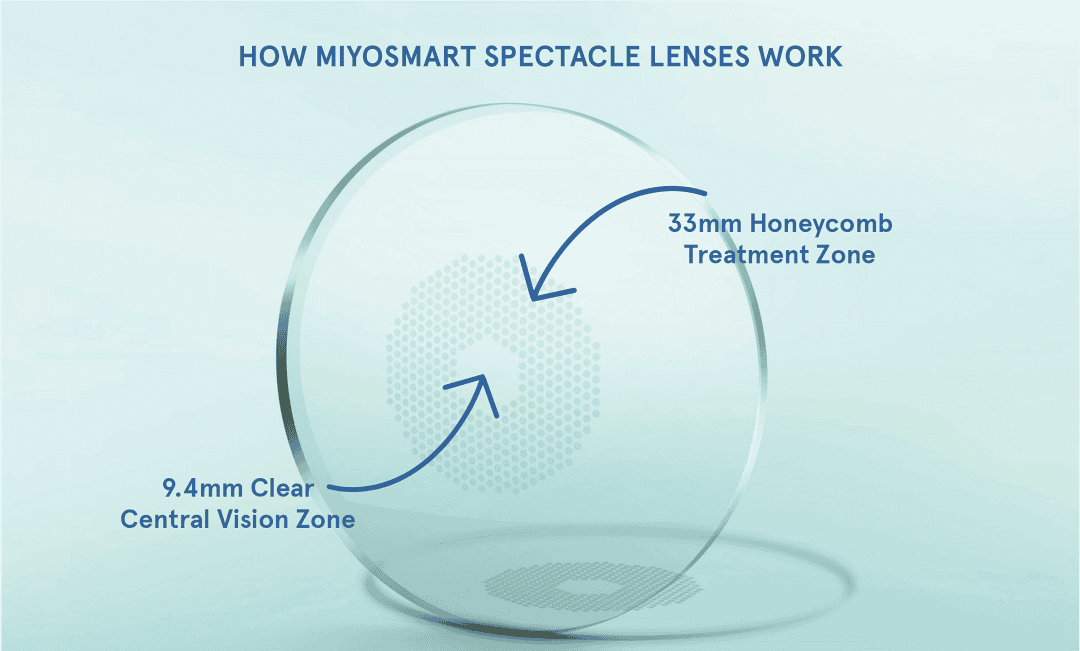
MiYOSMART lenses use a design called DIMS, short for Defocus Incorporated Multiple Segments. The centre of the lens is a clear zone that gives your child sharp vision for everyday seeing. Around that clear centre sits a honeycomb-like ring of hundreds of tiny segments.

These segments create gentle myopic defocus, a soft signal that helps slow the eye’s growth, while your child keeps seeing clearly through the middle. It is non-invasive: there are no eye drops, no surgery and nothing your child has to think about. They simply wear their glasses as usual.

Need help with your child’s vision?

Getting the Best Results

How to Get the Best Results From MiYOSMART

MiYOSMART lenses work best when they are worn consistently and paired with a few healthy habits. Here is how to give your child the best chance of a good result.

If you would like, you can book a kids eye test as the first step.

Why Choose Eye Care for Kids for MiYOSMART

Expert MiYOSMART fitting at our Narre Warren and Caulfield clinics

Because MiYOSMART lenses only work when they are fitted precisely and worn consistently, who fits them matters. Here is what sets our fitting apart.

MiYOSMART fitting expertise

MiYOSMART lenses only deliver their benefit when your child looks through the clear central zone, so frame choice, fit and centration matter more than with ordinary lenses. Marvin has more than 20 years of experience fitting glasses on children’s faces.

The widest kids' frame range

We carry one of the widest ranges of children’s frames in Melbourne, including Tomato Glasses, so the lens is matched to a frame that fits properly and stays put through a busy school day.

A managed program, not a one-off

MiYOSMART works best with regular reviews. Marvin monitors how your child’s myopia is tracking and refits the lenses as they grow, so the glasses keep doing their job over time.

Trusted by other health professionals

GPs, paediatricians, school nurses and maternal and child health nurses refer families to us when they suspect a child’s vision needs closer attention.

Senior Optometrist, Dip Optom SA, FOA, MCOptom

Marvin Janet

Marvin Janet is an optometrist with extensive training and experience in paediatric and behavioural optometry, solving children’s eye problems and helping them succeed at school. Fitting MiYOSMART lenses for myopia control is part of that everyday work, paired with the right frame for each child.

Marvin is often referred to by Maternal and Child Health nurses, school nurses, GPs, paediatricians, teachers and other optometrists. He puts children of all ages at ease with his gentle, friendly and caring nature, which leads to more accurate assessments and better outcomes for your child.

With more than two decades’ experience as an optometrist, Marvin developed his interest in childrens’ vision at the School of Optometry at the Technikon Witwatersrand, South Africa. He continued his study of children’s vision at The University of Manchester. After migrating to Australia, Marvin furthered his proficiency at The University of New South Wales.

Marvin presents educational lectures to teachers at schools on childrens’ vision, and holds private practice in Melbourne, where the majority of his patients are children of all ages.

Eye Care for Kids has 2 convenient locations

Narre Warren

Casey Business Centre
Suite 5, 26-28 Verdun Drive
Narre Warren VIC 3805

Caulfield

Access Business Centres
Suite 7, 242 Hawthorn Road
Caulfield VIC 3161

Frequently Asked Questions

Common questions about MiYOSMART lenses

Do MiYOSMART lenses really work?

Yes. Clinical studies show MiYOSMART lenses slow myopia progression by up to 60% on average, compared with standard single-vision lenses (Lam et al., British Journal of Ophthalmology, 2020). A six-year follow-up found the effect was sustained over time. Results vary from child to child, so outcomes are never guaranteed.

How much do MiYOSMART lenses cost?

Costs depend on the lens and frame your child needs. Call (03) 9972 2722 to discuss fees and any health fund cover. Many private health funds offer a rebate on prescription lenses, including myopia-control lenses, so it is worth checking with your fund.

How long does my child need to wear them each day?

For the best results, MiYOSMART lenses should be worn near full-time: all waking hours, off only for sleep and showering. This consistent wear is what lets the lenses slow your child’s myopia. Wearing them only part of the time reduces the benefit.

Can MiYOSMART lenses correct astigmatism?

Yes. MiYOSMART lenses correct both short-sightedness and a degree of astigmatism. With an extended power range available, most children’s prescriptions are covered. Suitability is confirmed at an eye test.

At what age can my child start MiYOSMART lenses?

MiYOSMART lenses are most often fitted for school-age children whose short-sightedness is progressing, generally in the 6 to 18 range, though younger children can be suitable too. The right time to start is when myopia is detected and beginning to increase, because slowing it early offers the most benefit.

Can MiYOSMART lenses reverse my child's myopia?

No. MiYOSMART lenses are designed to slow how quickly myopia progresses, not to reverse short-sightedness that is already there. The goal is to keep your child’s prescription from climbing as fast as it otherwise would, which helps protect their eyes over the long term.