Children's Eye Tests
That GoBeyond 20/20

A children's eye test that checks the visual skills behind reading and learning, not just whether your child can see the board. Narre Warren and Caulfield.

What Marvin Tests (That Most Kids Eye Tests Miss)

Every kids eye test at Eye Care for Kids starts with the essentials. Marvin checks your child’s eyes for long-sightedness, short-sightedness and astigmatism, along with a thorough eye health examination and whether corrective lenses are needed. Everything a standard children’s eye test covers is included.

What sets this assessment apart is what comes next: the visual skills that directly affect how your child reads, concentrates and learns. These are the skills a standard vision test for kids typically does not assess:

  • Eye tracking: how the eyes move across a line of text when reading
  • Eye teaming: how both eyes work together to focus on the same point
  • Focusing ability: how quickly and accurately the eyes shift between distance and near
  • Visual perception: how the brain makes sense of what the eyes see

With more than 20 years of experience in paediatric and behavioural optometry, Marvin has the depth of expertise to identify visual skills problems that affect reading, concentration and school performance.

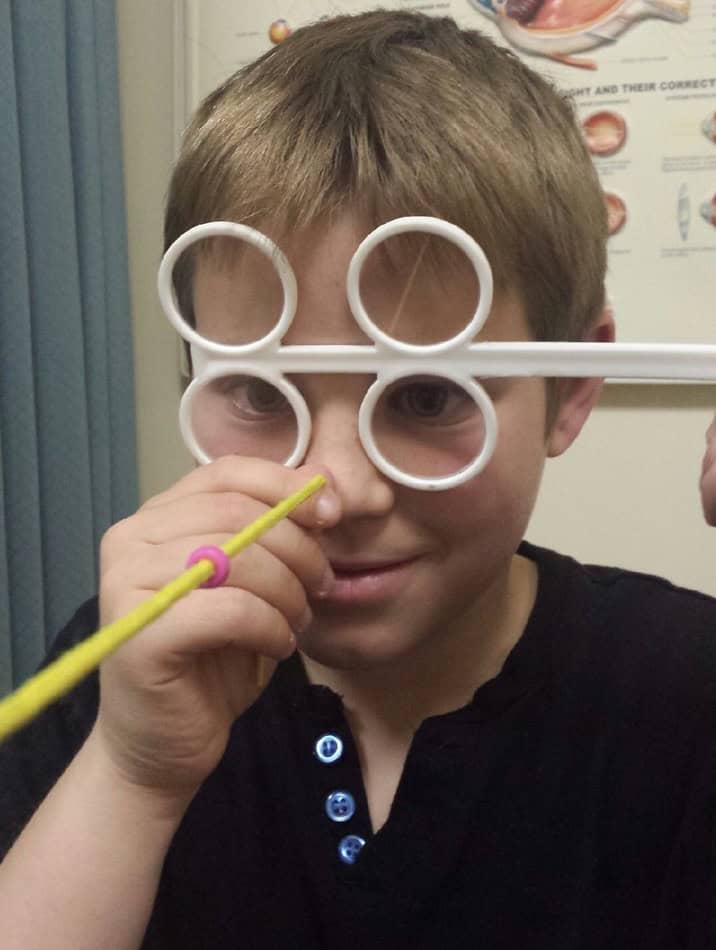
Brock getting an eye test at Eye Care for Kids
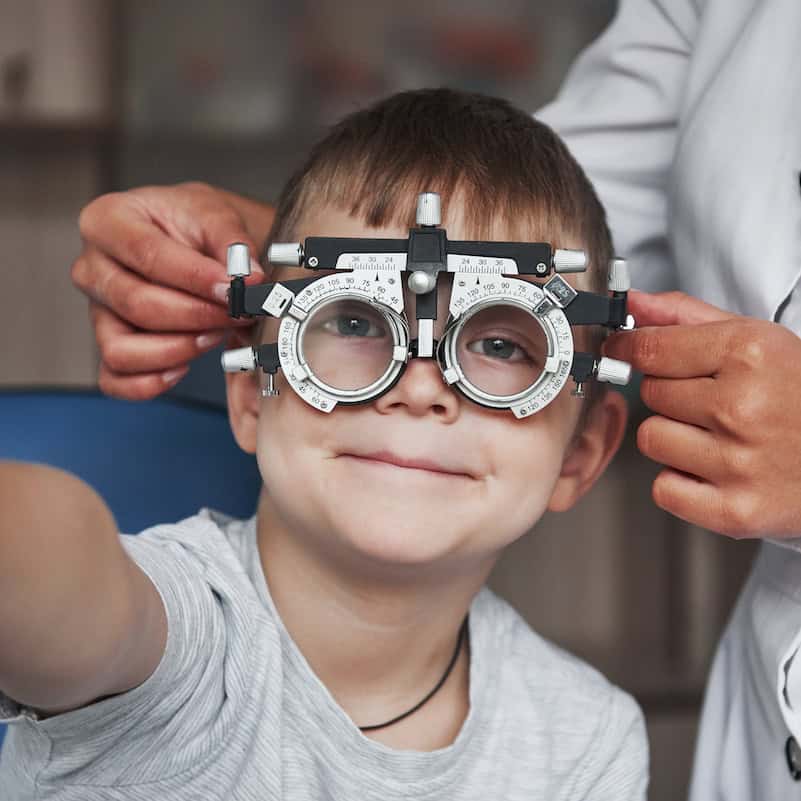
Child getting an eye test with a smile

Which Children Should Have a Kids Eye Test

A children’s eye test with Marvin suits a wide range of ages and concerns. It is worth booking an eye test for children who are:

  • Starting school or in their first year of primary school
  • Struggling with reading, writing or concentrating in class
  • Passing a standard eye test but still finding learning difficult
  • Flagged by a teacher, GP or school nurse for a vision concern
  • From a family with a history of eye problems or glasses
  • Toddlers and pre-schoolers, even very young children who cannot read yet

Your child does not need to know their letters or be able to read for an accurate eye test. Marvin uses age-appropriate methods that work from infancy through to the teenage years. Early detection matters, because most vision problems are far easier to address early than later in your child’s schooling.

Signs Your Child May Need an Eye Test

Vision problems do not always look like blurry vision. Some of the most common early signs show up at school or during reading at home, not at the eye chart. Signs to watch for include:

Other signs show up in learning and behaviour: avoiding reading or close-up work, a short attention span for reading tasks specifically, slow or messy handwriting, or performing below what teachers and parents expect. If you recognise any of these, an eye test can help work out whether a vision problem may be contributing. The only way to know for certain is a thorough eye test.

How Often Should Children Get Eye Tests?

Regular eye tests help support your child’s vision as they grow. As a guide:

  • First eye test: before your child starts school (age 4 to 5 is recommended)
  • School-age children: a check each year helps catch changes early
  • Children with identified issues: more often if a vision problem has been found or vision therapy is underway

Children’s visual development continues throughout primary school, so regular eye tests help identify problems before they affect learning. Early intervention, while your child’s visual system is still developing, gives the best chance of healthy eyes and clear vision long term. If you are unsure whether it is time, call us on (03) 9972 2722 and we can advise.

Need help with your child’s vision?

What to Expect

What to Expect at a Kids Eye Test

Parents often want to know what will happen before they bring their child in. Here is how a kids eye test at Eye Care for Kids works, step by step.

Marvin’s gentle approach puts children at ease, which means more accurate results. Most appointments take about 30 minutes, at either our Narre Warren or Caulfield clinic. If glasses, vision therapy or further support are needed, he explains why and what to expect.

Why Choose Eye Care for Kids

Children's eye tests at our Narre Warren and Caulfield clinics

A kids eye test is only as good as the person doing it. Here is what families get at Eye Care for Kids.

We test the visual skills others miss

Marvin tests eye tracking, eye teaming, focusing and visual perception, the visual skills behind reading and learning that a standard eye test does not check. It is the difference between whether your child can see and whether your child can read comfortably.

20+ years focused on children

Paediatric and behavioural optometry is Marvin’s whole focus, with more than 20 years of experience and training across South Africa, the United Kingdom and Australia.

A gentle approach that gets accurate results

A calm, friendly and unhurried test means your child cooperates better, which leads to more accurate findings. Children of all ages are put at ease, including toddlers and pre-readers.

Trusted by GPs, paediatricians and teachers

GPs, paediatricians, teachers and school nurses regularly refer children to us when they suspect vision is affecting learning. No referral is needed to book.

Senior Optometrist, Dip Optom SA, FOA, MCOptom

Marvin Janet

Marvin Janet is a Senior Optometrist (Dip Optom SA, FOA, MCOptom; AHPRA registration OPT0001061366) with more than 20 years of experience in paediatric and behavioural optometry, trained across South Africa, the United Kingdom and Australia. His focus is children’s vision: the visual skills that affect reading, learning and concentration.

Marvin is often referred to by GPs, paediatricians, teachers, school nurses and other optometrists. He puts children of all ages at ease with his gentle, friendly and caring nature, which leads to more accurate assessments and better outcomes for your child.

With more than two decades’ experience as an optometrist, Marvin developed his interest in childrens’ vision at the School of Optometry at the Technikon Witwatersrand, South Africa. He continued his study of children’s vision at The University of Manchester. After migrating to Australia, Marvin furthered his proficiency at The University of New South Wales.

Marvin presents educational lectures to teachers at schools on childrens’ vision, and holds private practice in Melbourne, where the majority of his patients are children of all ages.

Eye Care for Kids has 2 convenient locations

Narre Warren

Casey Business Centre
Suite 5, 26-28 Verdun Drive
Narre Warren VIC 3805

Caulfield

Access Business Centres
Suite 7, 242 Hawthorn Road
Caulfield VIC 3161

Frequently Asked Questions

Common questions about children's eye tests

At what age should a child have their first eye test?

Before starting school, around age 4 to 5, is a good starting point for most children. That said, children can be tested accurately from infancy. If you have concerns earlier, there is no need to wait: Marvin uses methods that do not require reading or verbal responses.

Can a 2-year-old have an eye test?

Yes. Eye tests for toddlers do not require your child to read letters or respond verbally. Marvin uses age-appropriate techniques designed for very young children, and testing is safe and reliable from infancy.

How often should children get eye tests?

A check each year is a good guide for school-age children. Their visual development continues throughout primary school, so yearly tests help catch changes before they affect reading and learning. If a vision problem has been identified, more frequent visits may be recommended.

How much does a kids eye test cost?

Fees vary, so contact the practice for current pricing on (03) 9972 2722 or at your appointment. We can also discuss any health fund rebates that may apply to your child’s eye exam.

What is the difference between a children's eye test and an adult eye test?

Children’s eye tests are typically longer and more thorough. They cover visual skills that are still developing, eye tracking, teaming, focusing and visual perception, which are not routinely tested in an adult eye exam. Marvin also uses child-appropriate methods and includes visual perceptual testing that is rarely part of a standard adult appointment.

Can vision problems cause learning difficulties in children?

Undetected visual skills problems can affect a child’s reading, concentration and school performance. Many children with learning difficulties have a vision component that was not identified, because a standard eye test only checks sight, not the visual skills involved in reading. A visual skills assessment can help work out whether vision may be contributing, and early detection gives the best outcomes.