7 Signs Your Child May Have a Hidden Vision Problem

Many parents are told at a school vision screening that their child’s eyesight is fine, yet something still seems off. Their child avoids reading, drifts off during homework, complains of headaches after school, or seems to struggle no matter how hard they try. The natural assumption is that it is a learning issue or an attention problem.
What many parents do not realise is that a standard vision screening only checks whether a child can read a chart at a distance. It does not test the visual skills the eyes use when reading: how the eyes track across a page, work together, or hold focus. These hidden vision problems slip through the cracks, and they are some of the most overlooked signs your child needs glasses or further assessment.
If any of the seven signs below sound familiar, it may be worth booking a children’s eye test that goes beyond a standard screening.
Key Takeaways
- Standard school vision screenings test distance sight only. They do not check visual skills like eye tracking, teaming or focusing.
- A child can have 20/20 distance vision and still have significant visual skills difficulties that affect reading and concentration.
- Commonly missed signs include avoiding reading, losing their place on a page, headaches after school, and concentration problems that can look like ADHD.
- Words appearing to move or blur on the page is a symptom of convergence insufficiency, a treatable visual skills condition.
- A comprehensive behavioural eye test can often identify these problems, even when a school screening was normal.
- Early identification means more treatment options and better outcomes at school.
Why Children Don’t Tell You Something Is Wrong
Children rarely report a vision problem, because they have never known anything different. A child whose words drift on the page assumes everyone sees that way. That is why these signs are behavioural, not verbal: you spot them in how your child acts, not in what they say.
A Note on School Vision Screenings
School vision screenings are designed to catch significant distance sight problems. They usually involve reading a letter chart from across the room, and they are useful for that.
What they do not test is just as important: eye tracking, eye teaming, focusing, and how the brain processes what the eyes see.
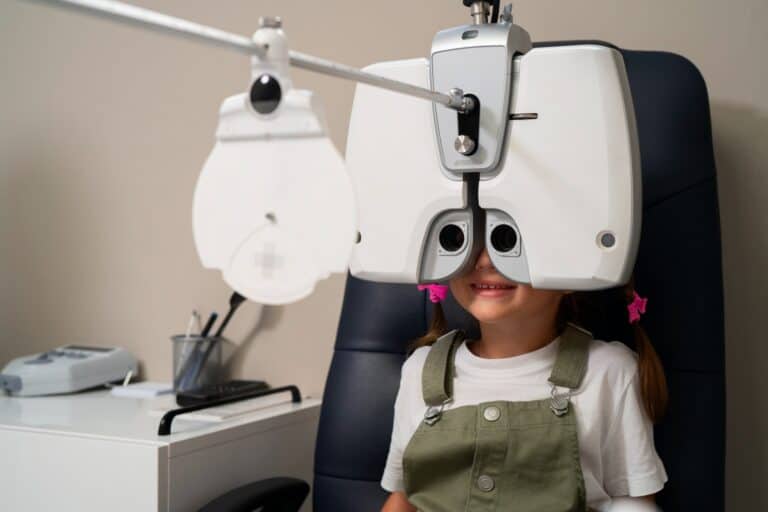
A behavioural eye test, like the kind offered at Eye Care for Kids, goes further than a screening. It tests the visual skills that affect reading, writing and concentration, the skills a screening does not check. To see what a fuller assessment involves, read what a comprehensive kids eye test covers.
The 7 Signs
Sign 1: Squinting at the Board, Screen or TV
Squinting narrows the amount of light entering the eye and briefly sharpens focus. It is an involuntary attempt to see more clearly.
Parents often notice it when a child watches television or copies from the whiteboard. Your child may not complain about their sight, because squinting helps them cope in the moment. It is one of the most visible signs of distance sight difficulty, and often the first hint a child needs glasses, though on its own it does not rule out other visual skills problems.
Sign 2: Sitting Too Close to Screens or Holding Books Very Close

Bringing things closer is a way of compensating for difficulty seeing at a normal distance. The closer the object, the clearer it tends to look.
You might notice your child sliding their chair forward in class or holding a book unusually close to their face. This can point to short-sightedness (myopia), which is usually corrected with glasses, but it can also signal difficulty sustaining focus, even in children whose distance sight is normal.
Sign 3: Headaches or Tired Eyes After School

Headaches after school, especially across the forehead or behind the eyes, are a common symptom of a visual system working harder than it should. The effort of keeping print clear all day can build into real discomfort.
Children with tracking, convergence or focusing difficulties often describe feeling “tired” after school, even after a quiet, desk-bound day. A child who seems wiped out by 3pm may have eyes that have been working hard just to keep up.
Sign 4: Losing Their Place, Skipping Lines, or Using a Finger to Read
Smooth, accurate eye movement across a page is a learned visual skill. Children who have not developed it lose their place, re-read the same line, or skip words without realising.
Using a finger to follow the text is a coping strategy for poor eye movement control. This sign is often read as a reading difficulty or carelessness. The real cause may be the eye tracking skills (saccades) the child relies on.
Sign 5: Avoiding Reading or Homework and Calling It “Boring”
A child who keeps resisting reading, drawing or writing may not be lazy. Close-up work can be genuinely uncomfortable, even physically, when the eyes struggle to work together at near distances.
“Boring” is often a child’s word for an activity that feels hard or hurts. It is especially worth noting if the avoidance is specific to near tasks, while your child happily throws themselves into physical play.
Sign 6: Concentration Problems That Look Like ADHD or a Behaviour Issue
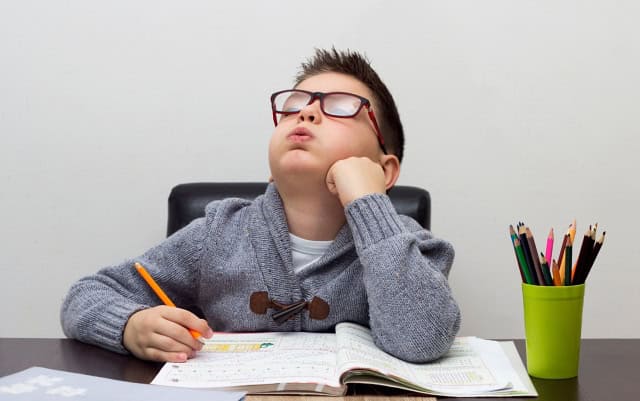
A short attention span during reading or written work, but not during other activities, can point to a visual skills difficulty rather than an attention disorder. When looking at a page is uncomfortable or effortful, attention naturally drifts.
This can be mistaken for ADHD, anxiety, or a general behavioural problem. The useful question to ask is simple. Does the concentration trouble show up mainly during visual tasks like reading, writing and copying, or across everything your child does? If it is mainly visual, vision is worth assessing as one possible factor.
Sign 7: Saying Words Move, Blur or Jump on the Page
When a child says words move, swim, double up or go blurry while reading, that is a classic description of convergence insufficiency. This is when the eyes struggle to turn inward together for close reading.
Children often do not mention it, because they assume it is normal. When asked directly, many will describe exactly this experience. It is also treatable. Many children with convergence insufficiency see improvement through a structured vision therapy program.
What to Do Next
If any of these signs are familiar, the most useful next step is a children’s eye test that checks visual skills, not just sight. An optometrist with experience in behavioural optometry will test tracking, teaming and focusing, not just whether your child can read the chart. A full kids eye test checks different things from a school screening, and it can give you a clear answer.
Frequently Asked Questions
How can I tell if my child has a vision problem?
Some signs are easy to spot: squinting, sitting very close to screens, or holding books close to their face. Others are subtler: avoiding reading, losing their place on the page, headaches after school, or concentration that fades only during visual tasks. If you notice any of these, an eye test that checks visual skills, not just sight, is the best starting point.
Can a child have a vision problem even if they passed a school eye test?
Yes, and it is more common than many parents realise. School vision screenings test whether a child can see a chart at a distance. They do not test the visual skills the eyes use when reading, such as eye tracking, teaming and focusing. A child can pass a screening with normal sight and still have visual skills difficulties that affect reading and learning.
What is the most common vision problem in children?
Short-sightedness (myopia) is the most common refractive vision problem in children, and it is becoming more common worldwide. It means distant objects look blurry while close-up vision stays clear, and it is usually corrected with glasses. Visual skills difficulties, such as eye tracking and eye teaming issues, are also common. They are simply checked far less often, because a standard sight test does not look for them.
Can vision problems in children be mistaken for ADHD or learning difficulties?
Yes. When reading is uncomfortable because of a visual skills problem, a child’s attention drifts. From the outside, that can look like ADHD or a reading disorder. Visual skills problems do not cause ADHD or dyslexia, and they are not the same condition, but they can produce similar classroom behaviours. If your child’s concentration trouble is mainly triggered by reading or near tasks, having their visual skills assessed is a worthwhile step.
Can kids’ eyesight improve?
It depends on what is causing the difficulty. Refractive problems like short-sightedness do not improve on their own and are managed with glasses. In children, a worsening prescription can sometimes be slowed through myopia control. Some visual skills difficulties, such as convergence insufficiency, can improve with a structured vision therapy program, because the eyes can be trained to work together better. An assessment is the only reliable way to know which situation applies.
At what age should my child have their first eye test?
Optometrists generally recommend a first comprehensive eye test before a child starts school, at around age 4 or 5, then regular checks through the school years. Visual skills develop fastest in the early years, so problems found early are generally easier to address. A school screening is not a substitute for a proper eye test, because they check different things.
Book Your Child’s Eye Test at Eye Care for Kids
At your child’s first appointment, Marvin tests their distance vision, close vision, and the visual skills behind reading and learning, including eye tracking, eye teaming and focusing. It is a gentle, child-friendly assessment, designed to put your child at ease so the findings are accurate.
Children’s eye examinations in Australia may attract a Medicare rebate, and no referral is needed to book. We can confirm what is covered for your child’s type of assessment when you call.
Narre Warren clinic Suite 5, 26-28 Verdun Drive, Narre Warren VIC 3805 Serving Berwick, Casey, Cranbourne, Pakenham and Hampton Park.
Caulfield clinic Suite 7, 242 Hawthorn Road, Caulfield VIC 3161 Serving Malvern, Armadale, Elsternwick, Brighton, Glen Eira and St Kilda.
Call (03) 9972 2722 or book online to arrange your child’s eye test at either clinic.
This content is for general information only and does not constitute clinical advice. Individual assessment findings and treatment outcomes vary for each child.

Marvin Janet is a Senior Optometrist (Dip Optom SA, FOA, MCOptom) with 20+ years in paediatric and behavioural optometry, helping children overcome the vision problems that get in the way of reading and learning.