Do MiYOSMART lenses really slow myopia progression in children?

Every year the prescription gets a little stronger. Your child squints at the board, the glasses get thicker, and at the last visit the optometrist suggested MiYOSMART lenses to help slow things down. They are not cheap, so it is fair to ask the obvious question first: do MiYOSMART lenses work?
The short answer is that this is one of the few areas of children’s eye care backed by solid clinical trials, not just marketing. MiYOSMART lenses are a form of myopia control designed to correct your child’s vision and slow how fast their short-sightedness gets worse, and they have real evidence behind them.
This article walks through how the lenses work, how well they work according to the research, and the honest limits, including why they do not work equally well for every child.
Key Takeaways
- Yes: clinical trials show MiYOSMART lenses slow myopia (short-sightedness) progression by up to 60% on average compared with standard single vision lenses.
- They use DIMS technology (Defocus Incorporated Multiple Segments): a clear centre for normal vision, with a ring of tiny defocus segments that signal the eye to slow its growth.
- The myopia control effect held up over six years of follow-up.
- They work best when worn near full-time. Results vary, and a small number of children still progress.
- MiYOSMART slows myopia. It does not reverse or cure it.
The short answer: do MiYOSMART lenses work?
Yes. Clinical trials show that MiYOSMART lenses slow the progression of myopia in children by up to about 60% on average, compared with ordinary single vision glasses. In other words, the short-sightedness still tends to increase, but more slowly than it otherwise would.
It is worth being clear about what “up to 60%” means. It is an average across a group of children in the studies, not a guarantee for any one child. Some children respond more strongly than that, and a few respond less. The two biggest factors in how well the lenses work are how often they are worn and how well they are fitted.
How do MiYOSMART lenses work?
Worsening short-sightedness is mostly driven by the eyeball growing too long from front to back. Optometrists call this measurement the axial length, and too much axial elongation is what pushes the prescription up. MiYOSMART lenses are designed to gently slow that excessive eye growth.
They do this using a lens design called DIMS, short for Defocus Incorporated Multiple Segments. It sounds technical, but the idea is simple.
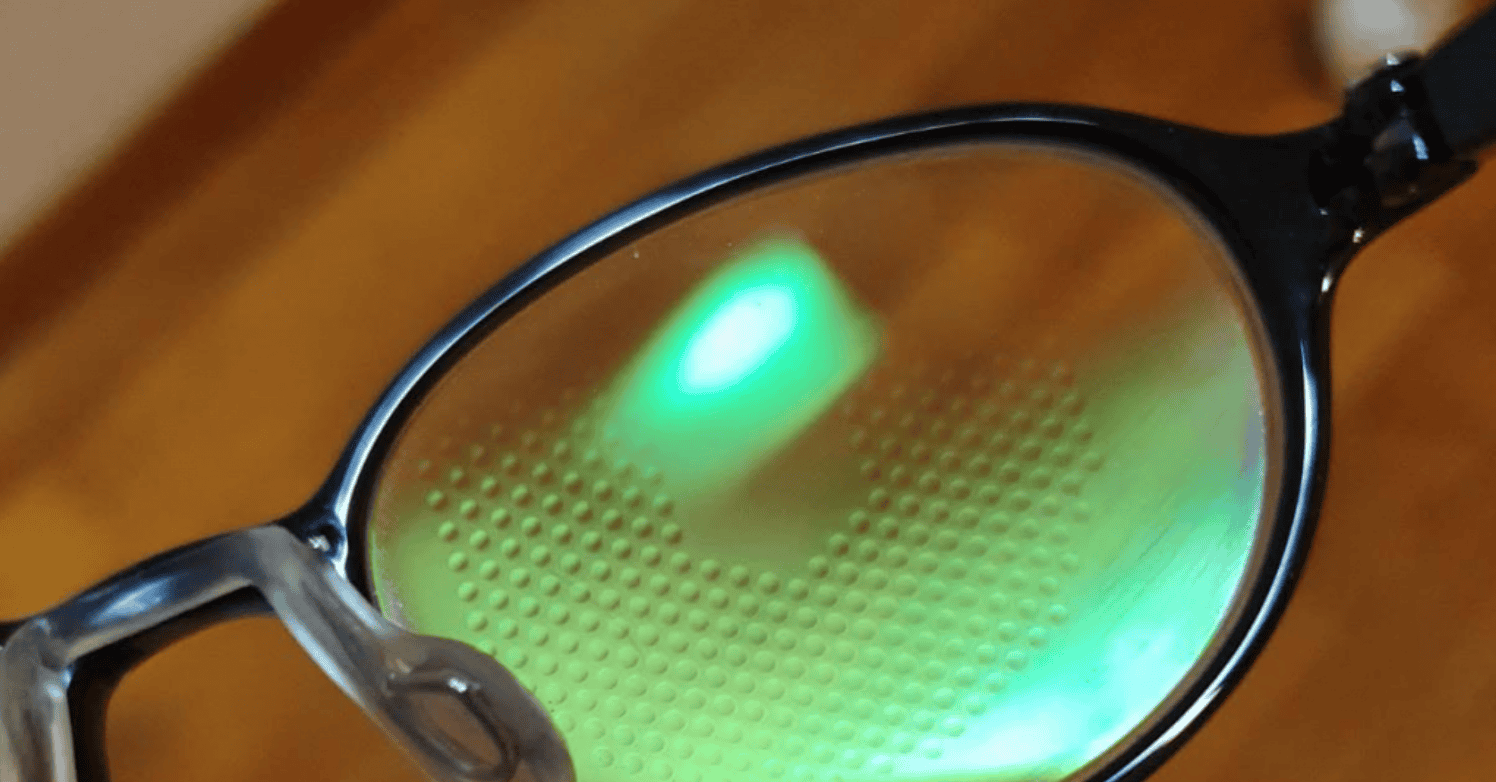
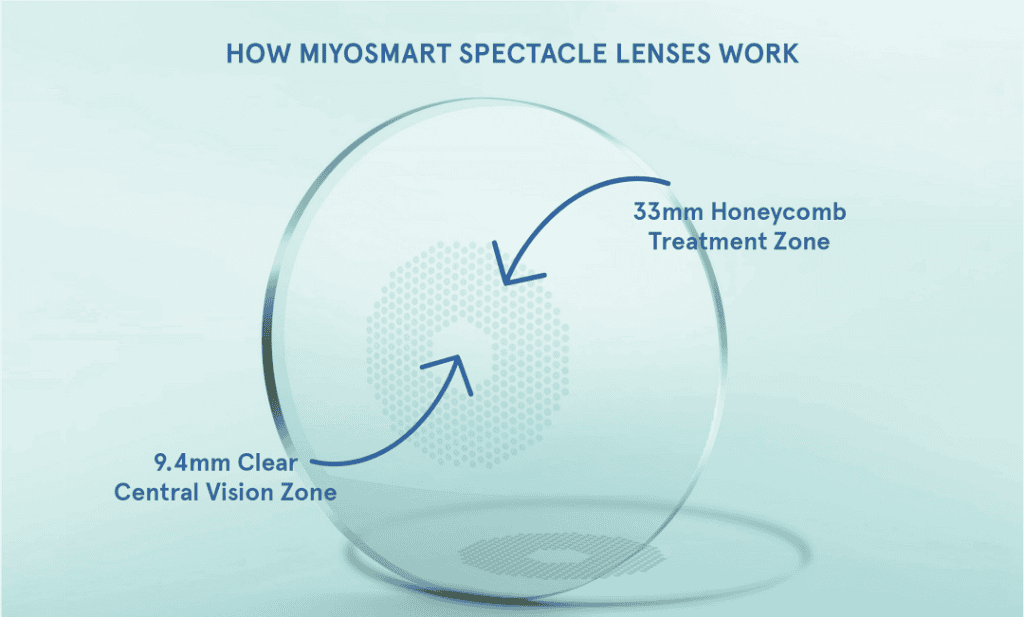
The centre of the lens is a clear zone, so your child sees sharply through it for normal vision correction, just like regular glasses. Surrounding that central clear zone is a ring made up of hundreds of tiny segments, arranged in a honeycomb pattern. These multiple segments create what is called myopic defocus: a soft, out-of-focus signal in the peripheral retina that tells the eye to ease off on its growth. Because the signal sits in the peripheral vision, this is sometimes described as peripheral defocus.
So the lens does two jobs at once. The clear centre gives your child crisp vision so they can see distant objects like the board and read comfortably. The ring of segments works quietly in the background to slow the eye’s elongation over time.
From the outside, MiYOSMART glasses look like regular glasses. The lenses are non-invasive: there are no contact lenses to insert and no eye drops to remember. They are made from impact-resistant polycarbonate, with anti-reflective and UV protection built in, which suits active kids. For many families, that makes them a straightforward option to fit into daily life.
What does the evidence actually say?
This is where MiYOSMART stands apart from many products marketed to parents: there is real clinical research behind it. The lenses were developed by Hoya together with The Hong Kong Polytechnic University, and first launched in 2018.
The main study was a two-year randomised controlled trial (Lam et al., British Journal of Ophthalmology, 2020). A randomised controlled trial is the gold standard of medical research, because children are randomly assigned to different lenses and then compared. In that trial, children wearing MiYOSMART lenses had on average around 60% less myopia progression, measured in both prescription and axial length, than children wearing standard single vision lenses. Notably, in the two-year trial around one in five children (about 21.5%) showed no measurable progression at all while wearing the lenses.
The natural next question is whether the effect lasts, or whether the eye simply catches up later. A six-year follow-up (Lam et al., 2023, Scientific Reports) looked at exactly that, and found the myopia control effect was sustained over the longer term.
Why does slowing progression matter beyond thinner glasses? Higher levels of myopia are linked to a greater long-term risk of serious eye diseases later in life, such as retinal detachment (where the light-sensitive layer at the back of the eye pulls away) and myopic maculopathy. Keeping myopia lower may help reduce that long-term risk of these conditions.
Do they work for every child?
This is the honest part, and it is the question most parents really want answered.
“Up to 60% on average” means results genuinely vary. Some children respond very well. A small number keep progressing at a faster rate despite wearing the lenses. That is normal, and it does not mean anything has gone wrong.
The two biggest variables are wearing time and fit. Lenses sitting in a school bag cannot slow anything, and frames that slip down the nose move the clear centre away from where the child is actually looking. Early intervention also helps: starting while the child’s myopia is still mild and the eyes are still growing gives the lenses more room to work.
This is one area where fitting experience matters. An optometrist experienced in fitting MiYOSMART lenses can check whether the frame and lens are centred correctly, and whether a change in approach is needed.
If a child continues to progress, their optometrist may adjust the plan rather than simply carry on. That might mean adding low-dose atropine eye drops alongside the lenses, or moving to a contact-lens-based option. The point is that MiYOSMART is one tool, and the approach can be reviewed if it is not doing enough.
MiYOSMART vs other myopia control options
MiYOSMART is not the only way to manage myopia in children. Here is a brief, neutral overview of the main options.
Single vision lenses. Standard glasses correct your child’s sight so they can see clearly, but these traditional glasses do not slow how quickly the myopia gets worse. They influence how your child sees, not how the eye grows.
Myopia control glasses (MiYOSMART, and others such as Stellest lenses). These are spectacle lenses designed to correct vision and slow progression at the same time, and are clinically shown to help slow myopia in children. They differ mainly in their lens design and how they create the defocus signal.
Myopia control contact lenses (for example, MiSight). An alternative for older children who can manage putting in and caring for contact lenses.
Low-dose atropine eye drops. Sometimes used on their own, and sometimes combined with other options, for children who keep progressing.
Orthokeratology (ortho-K). Special contact lenses worn overnight that temporarily reshape the front of the eye.
The right option depends on your child’s age, prescription, lifestyle and how they respond. An optometrist can help assess which approach suits them best.
How to get the best results from MiYOSMART
The lenses can only work when they are being used properly. A few habits make a real difference.
Wear them near full-time. That means all waking hours, off only for sleep and showering. Part-time wear gives part-time results. Most children settle into an adaptation period of a week or two, then barely notice the lenses.
Spend time outdoors each day. Time outside is one of the simplest things linked to slower myopia progression in children.
Take regular screen breaks. Long stretches of close-up focus, on tablets and phones especially, are thought to add to eye strain and eye fatigue.
Keep up with review appointments. Monitoring myopia progression at each visit lets the optometrist track how things are tracking and update the prescription or refit the frames as your child grows.
Fit matters most of all. If the frames slip, your child ends up looking through the wrong part of the lens, and the benefit is lost.
Frequently asked questions
Are MiYOSMART lenses worth it?
For many families, yes. They are one of the few myopia control options backed by a randomised controlled trial and a six-year follow-up, showing they can slow myopia progression by up to about 60% on average. The value depends on how consistently your child wears them and how well they are fitted. Your optometrist can talk through whether they suit your child’s situation.
Can MiYOSMART lenses reverse my child’s myopia?
No. MiYOSMART lenses are designed to slow how quickly short-sightedness gets worse. They do not reverse short-sightedness that is already there, and they are not a cure. The goal is to keep your child’s prescription from climbing as fast as it otherwise would.
How long does my child need to wear MiYOSMART lenses each day?
They work best worn near full-time: all waking hours, taken off only for sleep and showering. The more consistently they are worn, the better this myopia control effect tends to be. Wearing them only part of the day reduces the benefit.
How effective are MiYOSMART lenses compared with normal glasses?
In clinical trials, children wearing MiYOSMART lenses had on average around 60% less myopia progression than children in standard single vision glasses. Regular glasses correct your child’s sight but do not slow the underlying progression at all. That is the main difference between the two.
At what age can a child start MiYOSMART lenses?
MiYOSMART lenses are designed for children, and are generally used in school-age children through the teenage years. Myopia control is most useful while the eyes are still growing and the prescription is still changing. The right time to start depends on the individual child, so an optometrist can advise based on an assessment.
Do MiYOSMART lenses work as well as myopia control contact lenses?
Both spectacle lenses like MiYOSMART and myopia control contact lenses are used to slow progression, and each suits different children. Glasses avoid the handling and hygiene side of contact lenses, which can make them easier for younger children. An optometrist can help weigh up which option fits your child’s age, prescription and lifestyle.
Talk to us about myopia control for your child
At Eye Care for Kids, Marvin Janet has more than 20 years of experience in paediatric and behavioural optometry, including fitting MiYOSMART lenses. At a myopia assessment, your child’s vision and eye growth are checked, the options are explained in plain language, and any lenses are fitted and centred carefully so they can do their job.
You can learn more about MiYOSMART lenses, explore our myopia control approach, or start with a kids eye test.
We see children at two Melbourne clinics, Narre Warren and Caulfield. To book an assessment, call (03) 9972 2722 or book online.
This content is for general information only and does not constitute clinical advice. Individual assessment findings and treatment outcomes vary for each child.

Marvin Janet is a Senior Optometrist (Dip Optom SA, FOA, MCOptom) with 20+ years in paediatric and behavioural optometry, helping children overcome the vision problems that get in the way of reading and learning.